Wednesday, 25 January 2012

CATTLEPUNK: Character Concepts

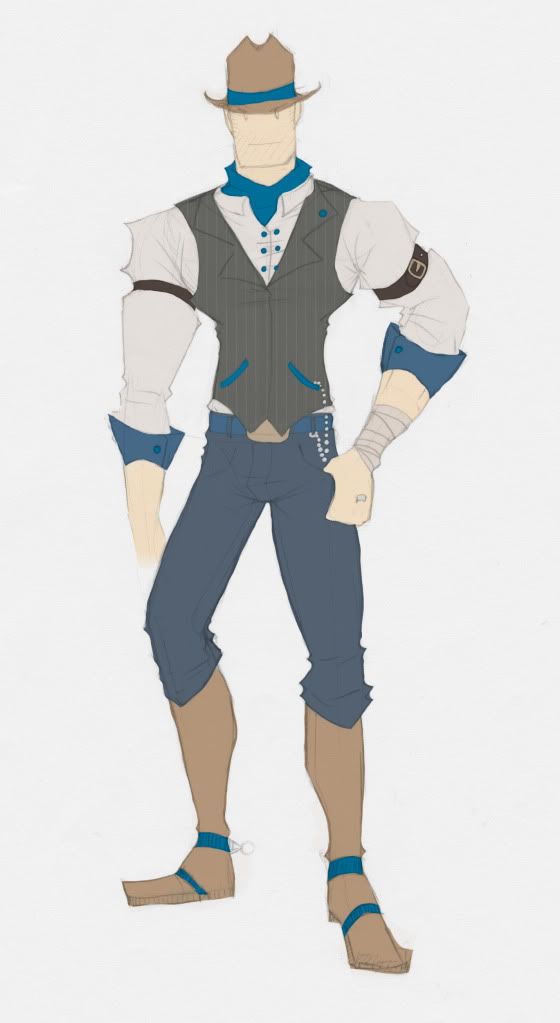
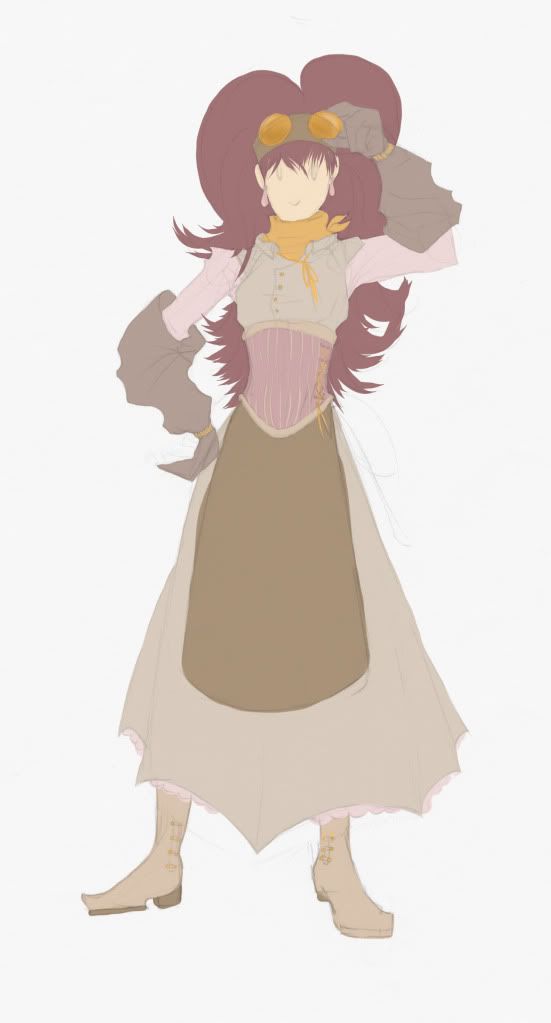
Here are some concepts for Sheriff Amadeus and his niece, Mandy, for our game project. These started out as idea sketches and progressed into thinking about colours.

Important things to remember when designing characters for use in 2D:
  • Clear shapes -- silhouettes must be instantly recognisable and characters should be defined clearly.
  • Distinctive colours -- the characters should be recognisable by colours, or have a 'key' colour associated with them, for use on menus and the like.
  • Simplicity in design -- a lot of detail will be lost in the transition to sprites.
Why is shape important? Characters need to be easily identified, or you end up with a Mortal Kombat-esque mashup of identical frames and ninjas! I struggle to keep up with battles where the characters are all palette swaps of each other.

Why is colour important? We should be able to tell which characters are on the screen at a glance and whose name is whose on menus. Red and Dark Red are far too easy to confuse, for example.

Why do we lose so much detail?
There is only so much screen and thus, only so much room for sprites. They need to be stylish and clear in 2D.


Amadeus: BLUE, TAN


Mandy: ORANGE, PINK, WINE RED


//RETRO AND NOSTALGIA

It took a bizarre detached contemplation while at my desk to come to the conclusion that I am not a very nostalgic person. I was ever so sure of my words that I deemed it appropriate to flag down our lecturer and explain as such to him, but I would like to say that I am awfully sorry, James, but I am afraid I lied to you.

Once it triggered in my brain that Bulletstorm (one of my most enjoyed and gushed over games of 2011) evoked these foreign-seeming feelings, it all became apparent. The reason behind this is that guiding Grayson Hunt through his foul-mouthed, hyperviolent romp of an adventure reminded me of the anarchy that Serious Sam pulled off so damn well in the late 90s; recollections of enjoying FPS when I was younger had endeared the game to me. I had an urge to draw crossover fanart of Grayson Hunt, Sam Stone and Duke Nukem drinking beers with Doomguy while mouthing off and waving their machismo around. Is this what nostalgia is? As I came to terms with this, I considered how some of my favourite games fondly throw back to the games and films that their developers were inspired by. GOD HAND's nod to Castlevania on its map screen and its chiptune minigame music, the Grindhouse lust of MadWorld, everything about the runup to and launch of 2010's Splatterhouse (an old favourite of mine) and most egregiously, No More Heroes: Desperate Struggle's minigames being entirely in 8-bit style.

Bloody hell, I thought. Well off the mark, aren't I?

The reason I spoke with such frowny-faced certainty, declaring my robot-esque lack of lusting after days gone by and familiarity, is that I have never thought of old games or games I played a long time ago as lost, forgotten or far away. They are very much still current-- they are still in my collection, easily found online or out in the shops. Nostalgia stems from things being in the past, remembered fondly, which is why it caught me unaware. Or so I like to think.

A branch of nostalgia, a certain type of memory was also present. By using our memories of games past, we recognise patterns and symbols in new games. An oft-cited example would be "Red barrels explode, shoot them to incinerate everything around you". While playing Bulletstorm, I realised that the best strategy was to charge straight in and start kicking the hells out of everything and shooting them in the face, much as Serious Sam was. By placing little reliance on cover, I began to play the game as I had years ago. I would argue that this is not so much nostalgia as ingrained tropes, patterns and cliché we have come to accept as part of gaming culture, tried and tested by time... but it would certainly take another waffling explanation.

Retro is something engrained in gaming culture so much so that we don't seem to realise it most of the time. With the rise of gaming culture's visibility and more 'mainstream' appeal, there are more and more people wearing t-shirts with Pacman on, Zelda trucker hats and messenger bags with big NES controllers printed on them. Old games being re-released on current-gen consoles make it easier than ever to access the games we may have enjoyed in years gone by or be introduced to classics we may have missed the first time around. But how many of these people with their amusing silk-screened shirts are 'truly' involved in the culture of retrogaming itself? There is something of a difference between remembering playing Zelda on the Nintendo 64 and remembering a code for infinite time in Manic Miner, or even to go so far as to wear a shirt with it emblazoned on the chest!

Nostalgia gives people something to connect with others with. Retrogaming is something of an exclusive club-- it's something niche within a niche and many people that play games casually may not even be aware that it exists. The dedication within the community is something that seems only matched by the otaku with their passion (one could even call them Retro-otaku). In Suominen's article, he speaks of how the consumption of rock music in recent years has been higher than it was thirty years ago. This is, naturally, because those who consumed the culture as youths have not let it go; as performers have aged, so have their audiences and new generations have been drawn in. He also explains that recent research has shown that those aged thirty-five or more are more likely to play games on a PC and those under favour consoles more strongly. Much like rock music, the early adopters of gaming are growing up-- Suominen reminds us that gaming being prevalent in popular culture is not a new thing by far. You only need to ask someone from the early 80s about Pac-Man to see the results!

It's easy to forget that video gaming is still a relatively young media. The current of today is the retro in ten years-- it shocked me that the Dreamcast and Gamecube are considered retro by some. I remember buying my Gamecube on launch day, does this make me a retro player or a young upstart?

Retro means different things to different people-- what one person considers retro (Crash Bandicoot) and another (Adventure) can be wildly different. As the generatins that grew up with video games grow older, the generations after them will consider yesterday's current-gen console a dinosuar. Ultimately, the games industry is a fast-paced, ruthless one; Retro will continue to evolve and it will always be a part of our gaming cultural heritage.
//MORALITY IN GAMES

Morality is a strange thing in games.

For many people, gaming is an escape from life and the depressing drudgery of having to be 'a good person'; when they sit down after a hard day's work, they want to let off steam as opposed to pondering existential questions and the nature of mankind. There is nothing wrong with this, which I shall say from the outset! It's simply that not everybody has the compulsion to  run about and kill everything that moves. No, some people believe that video games are a good platform for teaching practical wisdom.

Though the argument has not started recently at all. It stretches back all the way to the classic philosophers, with Plato having something to say for it. Back then, of course, Plato was not simply mad that Aristotle was kicking his rear at Street Fighter II, but rather found fault with art as a whole. He condemned it as being deceptive and intoxicating, which leads people to immorality by clouding the mind and hindering clear thought. His student, Aristotle, had a very different view (not just because he was great with Ryu); he argued that tragedy could make the audience into better people by using its cathartic quality to immerse them and allow them to experience the emotions of fear and pity in a controlled manner. He suggested that the messages and situations could be used by the audience and encourage them to apply the wisdom offered by the play in their daily lives.

If he were alive today and accustomed to our technology, I reckon Aristotle would rather like video games (not limited to  Street Fighter). If he were to play Fallout 3, Deus Ex: Human Revolution or Planescape: Torment, he would see that his musings certainly had some manner of effect somewhere down the line.  Simply being given the choice to make decisions that can be considered 'good' or 'bad' is something that is approved of in Aristotleian philosophy, as it is thought that this allows people to experience moral dilemmas in a controlled environment and thus, can grow as people.

Somewhat unsettling is that the arguments against gaming as a whole are not different these days as they were back in the days of Plato-- its detractors argue that such an intoxicating experience is detrimental to one's moral compass. One can consume violent images day in and day out and never lash out, though there are those more susceptible to such things. In a study conducted recently (Check it out here), it showed that the effects of violent imagery depends on the individual's personality-- someone with a tendency to frustration experiences things different to somebody that is incredibly mellow, for example. Yet on the other hand, video games are the first truly interactive media. Unlike films, books and comics, video games put you in the driver's seat.  Some may argue that moral decisions are everywhere in games today, even those that one would not originally consider as such. We often trivialise decisions that make or break entire countries in-game, or detach ourselves from the implications-- it's only a game, after all. ... Right?

In Fallout 3's expansion, The Pitt, the player is presented with a predicament so challenging that Bethesda could not allocate karma points for it. In this part of the story, the player charcter has the decision to either kidnap a baby and free a group of slaves or defend the child and allow the slaves to remain oppressed. Even cut down to an explanation simple as that, you can tell it's a toughie-- either honour one life and condemn many more or take one to benefit the larger group. This is something that one has to stew over, especially when it is in infant pulled into the equation.

From the perspective of Jeremy Bentham (more of an E. Honda kind of guy), happiness is the greatest good and morality should therefore be defined as acting the produce the greatest happiness for the greatest number of people. His school of thought is known as Utilitarianism and if placed in front of The Pitt and asked to make a decision, would likely opt for freeing the slaves. After all, this child is the key to their salvation-- why not grant them this?

As wonderful and sense-making this sounds, it is incredibly hard to judge what would be considered the greater good in almost any challenging situation. Where do you draw the line? When do the scales tip in favour of the majority? What about the minority?

This is the kind of wisdom that we need to keep in mind when making and playing games. The medium is pefectly suited to such conundrums and as such, we should continue to challenge ourselves with games for the contemplative.